Robotics announcements often celebrate the first pilot. That milestone is useful, but it mixes too
many kinds of effort: bespoke integration, unusually attentive engineers, temporary operating
procedures and customer goodwill. A first site can succeed while the product remains difficult to
scale.
A repeat site changes the question. The customer and supplier must decide which maps, interfaces,
safety controls, training, support processes and commercial terms can be reused. This is where a
robotics project starts becoming a service system.
Three levels of scaling evidence
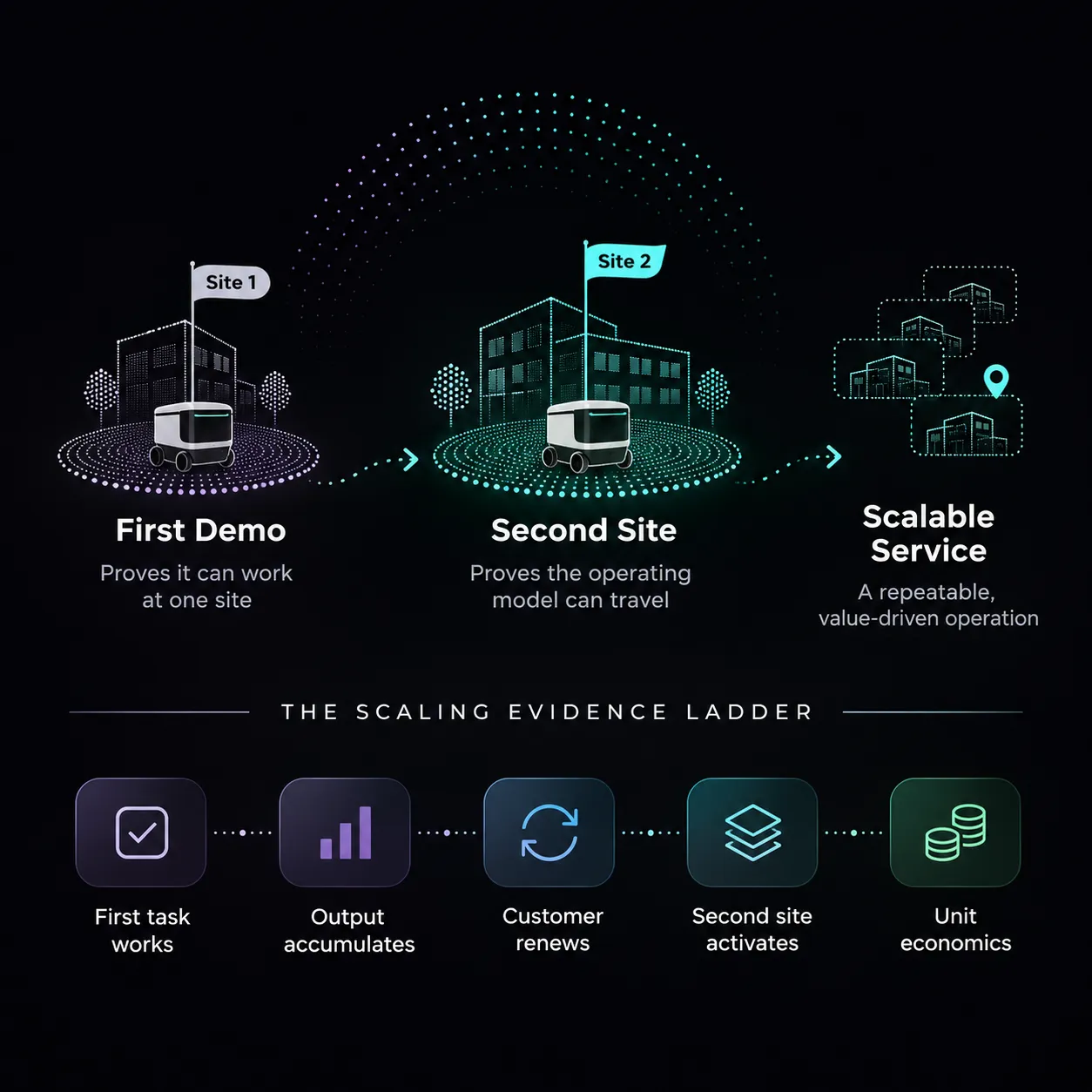
A useful evidence ladder separates technical capability from repeatable business value. First, the
robot completes the bounded task. Next, it accumulates enough output to expose maintenance and
exception patterns. Then the customer renews or expands. Only after a second site reaches stable
operation should the supplier claim a repeatable deployment model.
Recent examples show why this distinction matters
One live warehouse relationship has reported more than 100,000 tote moves and is now scheduled to
expand to two additional sites. In Japan, a Level 4 towing model has moved from two Tokyo airports
to a third airport in Fukuoka. In both cases, the new site is more informative than the original
headline because it requires the operating rules, service organization and safety evidence to travel.
What should be portable?
● Mission and site configuration, rather than custom software branches.
● Acceptance tests and measurable stabilization targets.
● Training, incident codes, remote-support rules and field-response procedures.
● Safety artifacts, version tracking and change-control triggers.
● Pricing for activation, integration, recurring service and excess support.
A proposed Fainzy RaaS model would use a formal second-site gate. Expansion would require
minimum mission volume, an intervention ceiling, availability, customer outcome, safety
performance and contribution margin. The next site would then use a standard activation pack and
priced exceptions. This is a proposed strategy, not a statement that Fainzy has already achieved
multi-site operating scale.