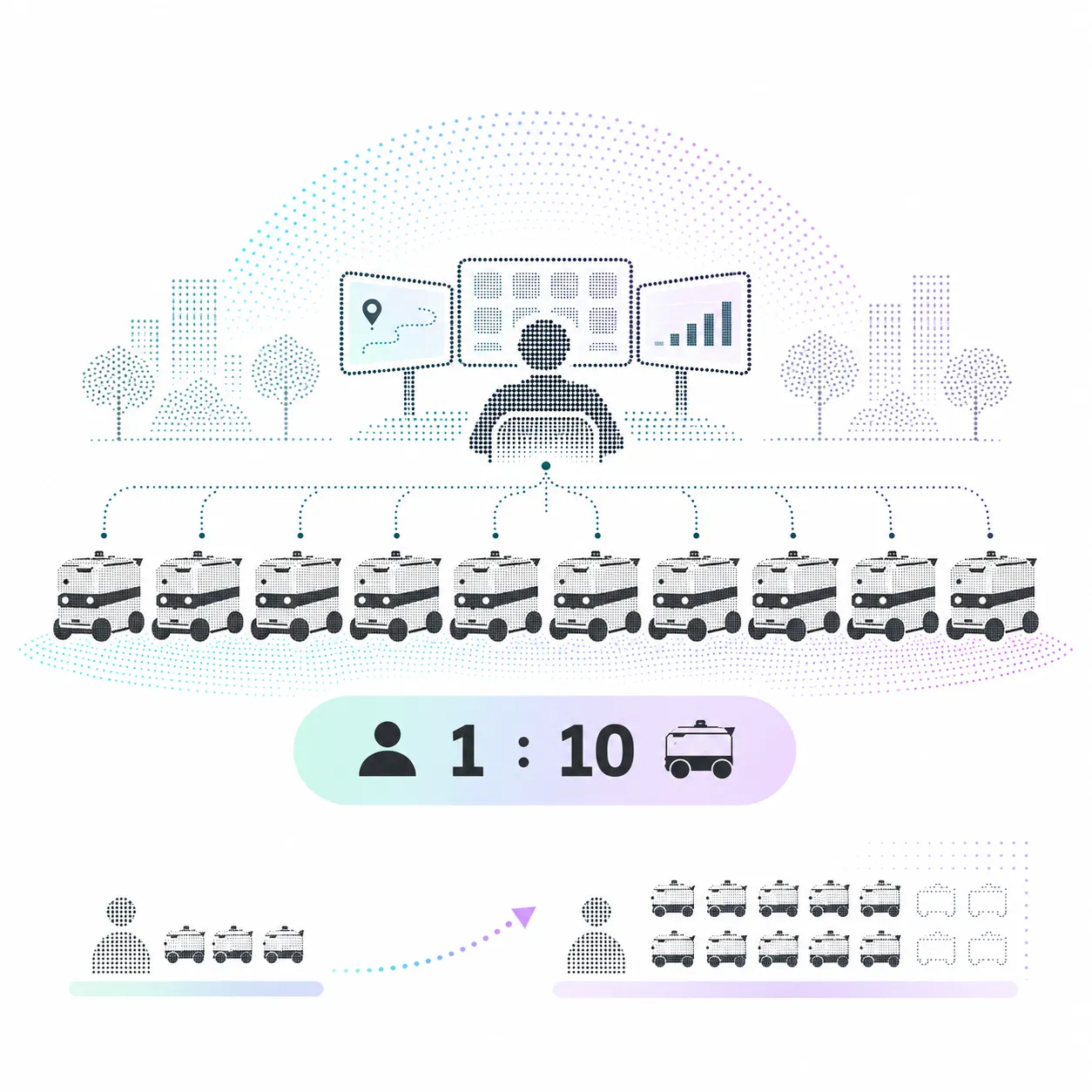
Delivery-robot announcements often begin with a map, a launch photo and a small fleet. Two years
later, the questions should be different. How many missions were completed? Did customers return?
Did monthly demand grow? How many robots can one supervisor oversee? Can the service meet a
promised time window?
A Japanese urban service has now disclosed a useful cluster of answers: more than 10,000 cumulative
deliveries, monthly volume 6.4 times the launch month, more than half of users returning, over 95
percent of orders arriving inside a selected 15-minute window, and a remote-supervision ratio of up to
ten robots per person.
One metric is never enough
Cumulative deliveries demonstrate exposure, but not customer value. Growth demonstrates adoption,
but not profitability. Repeat use signals utility, but may still depend on promotional pricing. On-time
performance measures the promise customers experience. The supervision ratio starts to reveal the
human cost behind autonomy. Together, the metrics form a more credible operating picture.
The supervision ratio belongs in the product brief
Remote assistance is often treated as an operations detail. It should be designed as a core subsystem.
A fleet needs prioritized alerts, clear robot state, low-latency video, safe command limits, automatic
incident capture and workload balancing. Ten nominal robots per operator is only useful if intervention
demand remains below the operator's safe cognitive capacity.
Expansion should test capability, not merely geography
The service is adding new neighbourhoods and temporarily testing a larger-capacity robot. That is a
strong experiment because payload volume and weight can change the eligible order mix. The right
comparison is not which robot looks more advanced; it is which platform completes more valuable
missions per robot-day without increasing intervention or field-support cost.
A proposed Fainzy pilot would report a weekly mission funnel alongside supervision economics:
eligible requests, assigned missions, completed missions, intervention minutes, on-time rate, repeat
use and contribution margin. ZiBOT capacity variants would be tested against real basket
distributions. This is a proposed measurement strategy, not a claim about Fainzy's current deployed
scale.
After two years, the most important robot-delivery story is not the robot. It is the operating system
that turns customer demand, human supervision and machine capacity into a dependable service.