The delivery-robot industry has spent years announcing pilot cities, robot counts and mapped
kilometres. Those numbers show activity, but they rarely answer the question that matters to an
operator: when an order could be assigned to a robot, how often does the robot actually complete it?
A recent urban expansion offers a more useful metric. After a year of operation in Jersey City, robots
reportedly completed nearly one in five deliveries from one participating location. The programme is
now expanding across four urban markets while keeping the customer inside the same marketplace
experience.
Robot share is a system metric
A 20 percent robot share is not merely a navigation result. It reflects the combined performance of
order eligibility, platform assignment, merchant acceptance, loading, route coverage, customer
opt-in, handoff and exception recovery. A failure at any one of these interfaces returns the mission to
a human courier or cancels it entirely.
That makes robot share a practical north-star metric, but only when the denominator is defined.
Teams should separate all marketplace orders from robot-eligible orders. A low robot share may be
caused by limited geography, unsuitable payloads, weather restrictions or poor merchant readiness
rather than weak autonomy.
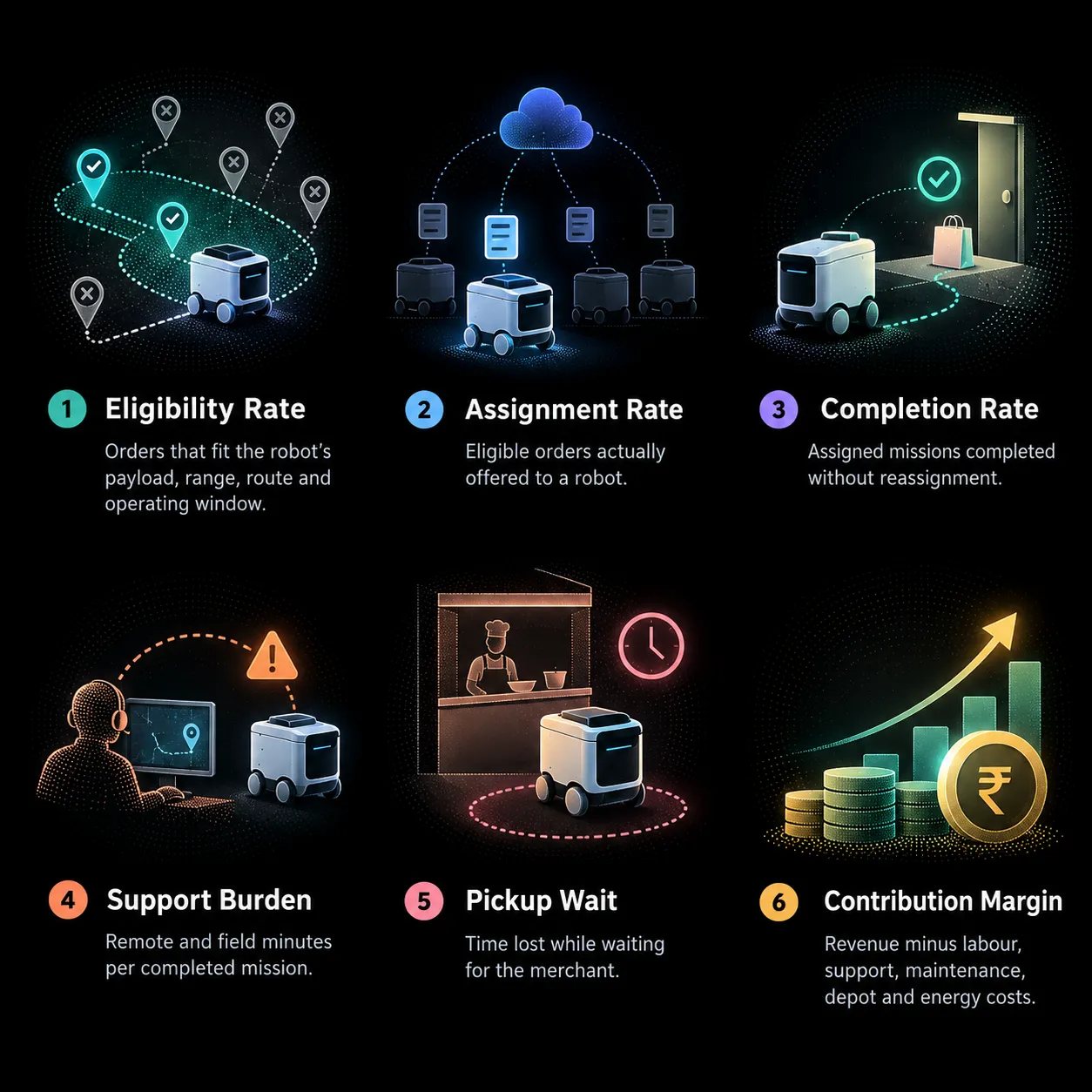
The metrics beneath the headline
● Eligibility rate: orders that fit the robot's payload, range, route and operating window.
● Assignment rate: eligible orders actually offered to a robot.
● Completion rate: assigned missions completed without reassignment.
● Human-assistance burden: remote and field minutes per completed mission.
● Pickup dwell: time lost while waiting for the merchant.
● Contribution margin: revenue minus labour, support, maintenance, depot and energy costs.
Design for the marketplace, not only the pavement
The successful service keeps ordering familiar. The customer opts in, the merchant receives training
and support, and the marketplace decides whether the robot is suitable. This creates an important
product requirement: the fleet manager must speak the language of orders, eligibility, ETAs, custody
and exceptions - not only robot poses and battery levels.
For indoor and outdoor delivery robots, the same logic applies. A hospital mission may be eligible
only when the lift is available and the receiving department is staffed. A campus food mission may be
eligible only when the merchant can load within a defined window. Autonomy is the capability to
move; service reliability is the capability to complete the workflow.
A proposed Fainzy pilot would define the eligibility rules before deployment and report the full
mission funnel every week. ZiBOT or an indoor platform would be evaluated on robot share within a
bounded operating design domain, together with intervention minutes and contribution margin. This
is a proposed measurement strategy, not a claim about current deployed performance.
The bottom line : The most credible scaling claim is not “we deployed more robots.” It is “robots completed a growing
share of the missions they were designed to serve, with declining human effort and improving unit
economics.”