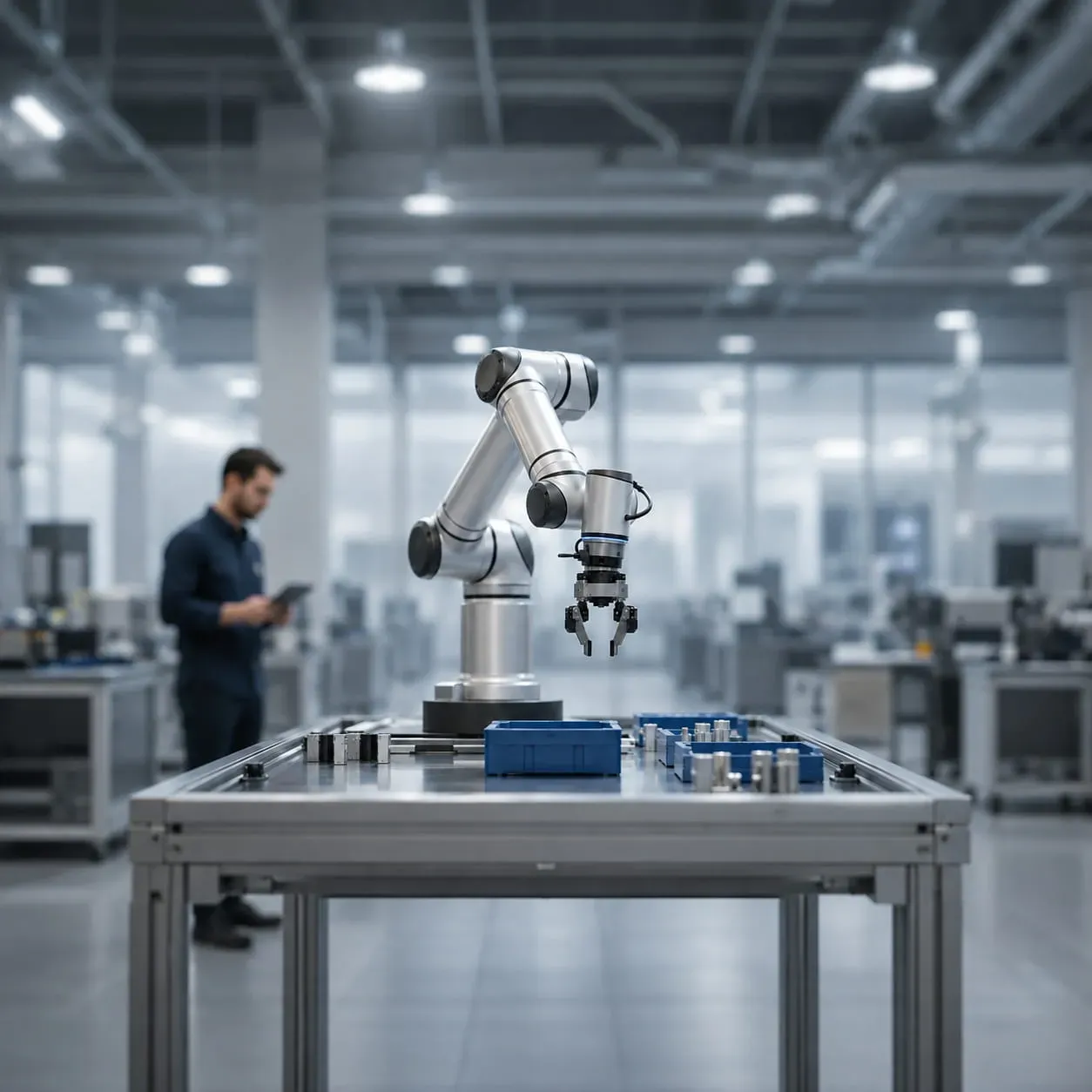
Collaborative robots, commonly known as cobots, are changing how businesses think about automation.
Rather than operating completely separately from people, collaborative robotic systems are designed for environments where humans and robots can work more closely together.
This creates an interesting opportunity: instead of asking whether robots should replace people, organisations can explore how human capability and machine capability can complement one another.
Robots bring consistency, precision, repeatability and endurance.
People bring judgement, adaptability, creativity, dexterity and contextual understanding.
Together, they can create entirely new ways of designing work.
What Are Cobots?
Collaborative robots are robotic systems designed for tasks in environments where people and robots may share the same workspace.
Depending on the application, cobots can assist with:
- Pick-and-place operations
- Machine tending
- Inspection and quality checking
- Packaging and sorting
- Light assembly
- Laboratory handling
- Material movement
- Repetitive manufacturing processes
Modern collaborative robotic systems can incorporate technologies such as force sensing, vision systems, proximity detection, speed monitoring and configurable safety functions.
However, simply calling a robot a cobot does not automatically make an application safe.
The complete system—including the robot, end-effector, payload, operating speed, environment and interaction with people—must still be designed and assessed appropriately.
Why Are Cobots Becoming Important?
Traditional industrial automation can deliver extremely high productivity, but it often involves fixed layouts, dedicated robotic cells, specialised infrastructure and significant integration effort.
Cobots provide another approach.
Their comparatively compact size and flexible programming can make automation practical for environments where processes change frequently.
This can be particularly useful for organisations dealing with:
- High product variety
- Small or medium production volumes
- Frequent process changes
- Repetitive manual operations
- Limited factory floor space
Instead of redesigning an entire workplace around automation, organisations can increasingly explore automation that adapts to the workplace.
Improved Productivity and Efficiency
Cobots can perform repetitive and predictable operations while people concentrate on activities requiring judgement, creativity and decision-making.
This can improve workflow efficiency without necessarily removing people from the process.
The objective is therefore not simply to automate as much as possible.
It is to identify where automation creates meaningful value.
Better Workplace Ergonomics
Many industrial activities involve repetitive movements, awkward postures or physically tiring work.
Robotic assistance can reduce the amount of repetitive physical effort required from workers.
For example, a robot may repeatedly position components while a person handles inspection, adjustment or assembly operations requiring greater dexterity.
This allows humans and machines to concentrate on the types of tasks each performs best.
Flexible Deployment
One important advantage of collaborative robotic systems is their potential flexibility.
A cobot can often be reprogrammed or redeployed when production requirements change.
For organisations producing different products in relatively small quantities, this adaptability can make automation more attractive than specialised machinery designed for only one operation.
Making Automation More Accessible
Traditional robotic automation can require substantial infrastructure, guarding, engineering and integration.
Collaborative systems can make selected forms of automation practical for SMEs (Small and Medium-sized Enterprises) as well as larger organisations.
Instead of automating an entire facility at once, a company can begin with a carefully selected repetitive process.
If that implementation proves successful, automation can gradually expand to other parts of the operation.
Human + Robot, Rather Than Human vs. Robot
Perhaps the most important idea behind collaborative robotics is that automation does not always need to become a competition between people and machines.
Different capabilities are valuable for different tasks.
Robots are particularly good at:
- Repetition
- Precision
- Consistency
- Predictable movements
- Operating for long periods
- Structured processes
Humans remain particularly strong at:
- Judgement
- Creativity
- Dexterity
- Communication
- Contextual understanding
- Problem-solving
- Handling unexpected situations
The more useful question therefore may not be:
“Which jobs can robots replace?”
Instead, organisations can ask:
“Which parts of a task should be automated, and which parts benefit most from human capability?”
Designing the Complete Workflow
Installing a robot does not automatically improve a process.
If the underlying workflow is inefficient, automation may simply allow that inefficient process to operate faster.
Successful automation therefore requires looking at the complete system.
Organisations need to consider:
- What should be automated?
- What should remain manual?
- How should people interact with the robot?
- What happens when something unexpected occurs?
- How should information move between people, machines and software?
- Can the system adapt when requirements change?
This is where robotics becomes more than a hardware problem.
It becomes a challenge involving systems design, human–machine interaction, operational strategy and service design.
The Road Ahead
As robotics, AI (Artificial Intelligence), computer vision, sensing and control technologies continue to evolve, collaborative robots are likely to become increasingly capable and adaptable.
Their applications may also extend far beyond conventional manufacturing.
Collaborative robotics can play roles in areas such as:
- Logistics
- Warehousing
- Laboratories
- Healthcare
- Food processing
- Inspection
- Packaging
- Hospitality
- Service environments
The future workplace may therefore contain fewer rigid boundaries between manual work and automation.
Instead, people, robots, software and intelligent systems may increasingly operate as parts of one connected workflow.
The organisations that benefit most may not simply be those that deploy the greatest number of robots.
They may be the organisations that understand where automation genuinely creates value—and where human capability remains irreplaceable.
The future is collaborative.