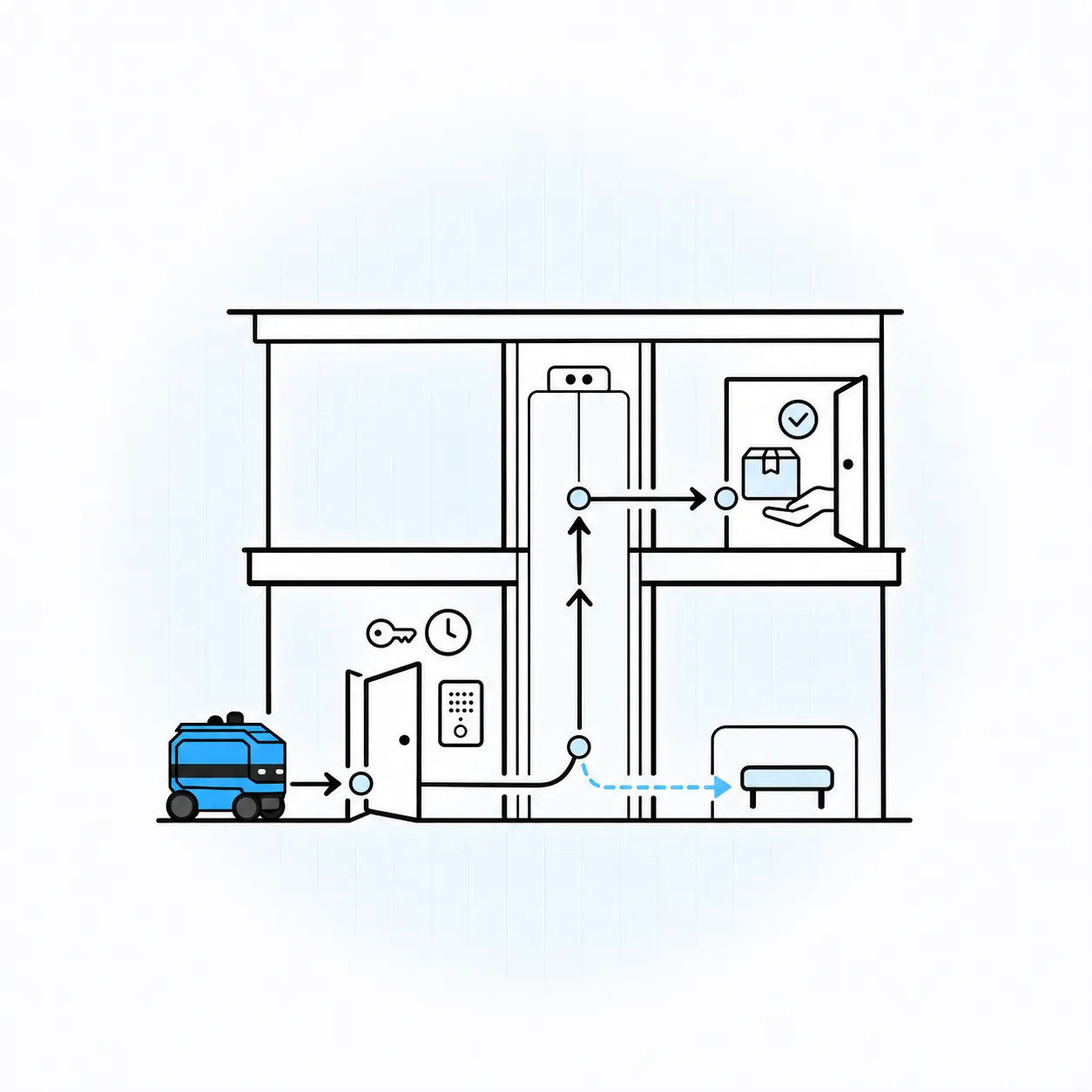
Apartment delivery compresses several difficult interfaces into a short distance. The robot must enter
a controlled building, call an elevator, travel to the correct floor, identify the residence and complete a
handoff without creating a security or accessibility problem.
A Fukuoka demonstration completed on 18 November connected a delivery robot with intercom,
package-unlock and elevator systems at a UR rental apartment. It tested both attended doorstep
delivery and unattended drop-off with a logistics operator participating. The important signal is not the
brief demonstration itself; it is the system boundary.
Access needs a permission chain
The mission should identify who authorizes entry, which doors and floors are permitted, when the
permission expires and how the robot behaves if a resident revokes access. Building credentials
should be scoped to one task rather than granting broad, persistent access.
Unattended delivery changes custody
A completed navigation mission is not necessarily a completed delivery. The system needs
cargo-presence sensing, compartment state, recipient authentication, NFC or QR events, tamper
detection and a return rule when the intended location is unsafe or unavailable.
Elevators create asynchronous failure
The elevator may be busy, inaccessible or taken out of service after dispatch. The robot needs
reservation and timeout logic, an accessible waiting position, a retry budget and a remote-assistance
path that does not block residents.
Design for residents who did not opt in
Apartment environments include children, older people, visitors and residents who may not want a
robot near their door. Clear identification, low-speed behaviour, privacy-preserving sensing and an
opt-out workflow are product requirements.
A proposed MiraX or ZiBOT building-delivery kit would combine temporary access credentials, elevator
and intercom adapters, NFC/QR custody events, cargo sensing, proof without persistent doorway
imagery, resident opt-out and a defined return-to-lobby process. This is proposed design direction, not
a statement of an existing Fainzy apartment deployment.
The last 30 metres is not primarily a navigation problem. It is a temporary-access, custody and
building-operations problem expressed through a robot.