When people picture autonomous logistics, they usually picture a robot moving through space. Real
deployments reveal a broader system. The robot must receive the correct load, stop precisely,
exchange custody, enter or leave a depot, coordinate with other machines and recover when
infrastructure is unavailable.
Japan's new autonomous-logistics-road programme makes those dependencies unusually visible. Its
test plan separates hub loading from corridor movement and measures details such as pallet
handling capacity, stopping accuracy, spacing between vehicles, merging, obstacle response,
required berth count and emergency intervention.
A handoff is a control problem
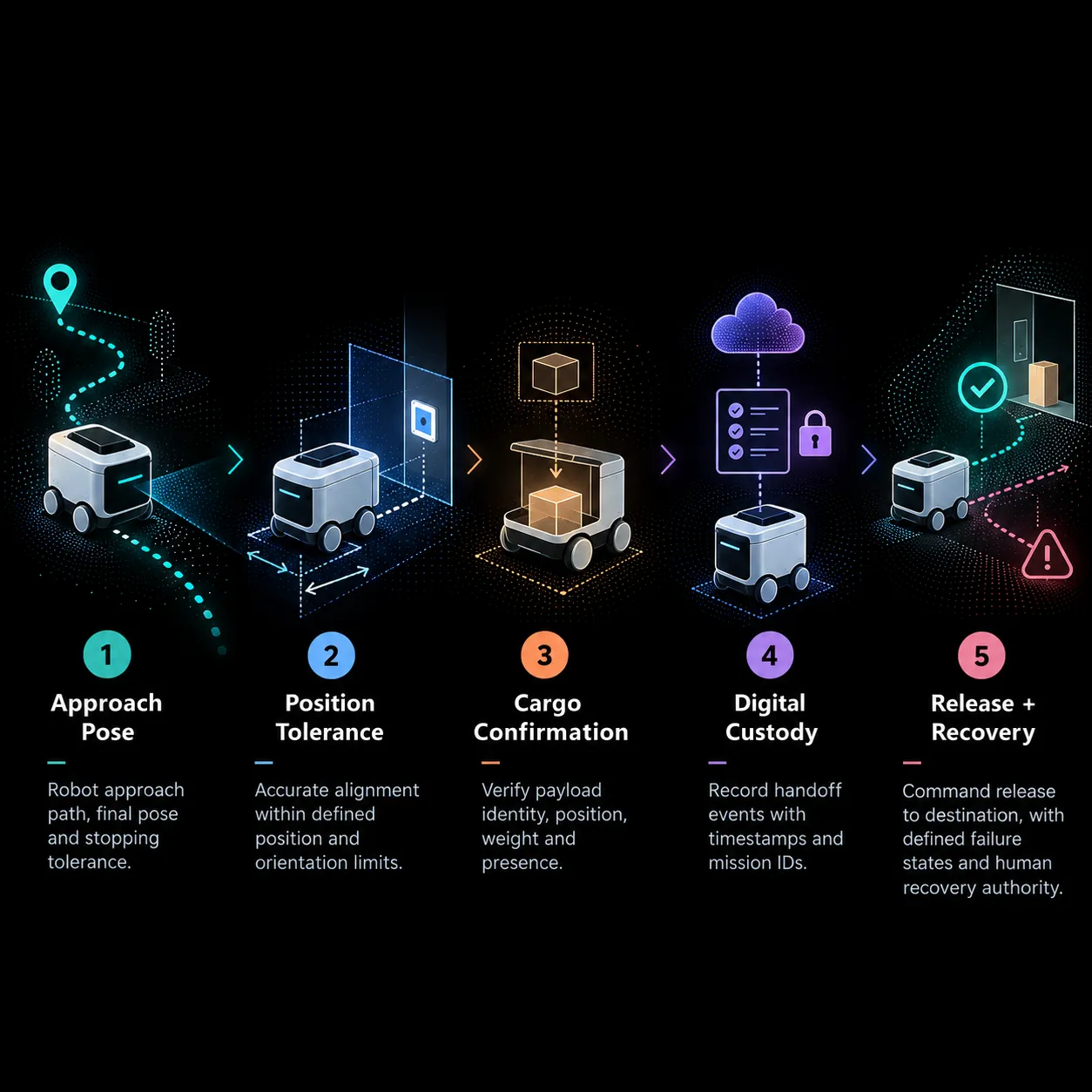
A cargo transfer is not complete merely because a robot arrives. The system needs a shared
coordinate frame, a stopping tolerance, a known payload position, positive cargo detection,
lock-state confirmation and an authority model for recovery. Without these, the operation depends on
a person silently correcting alignment and custody errors.
Repeatability is more valuable than customization
A separate Japanese deployment provides the complementary commercial lesson. A goods-to-person
system used at one distribution centre is being repeated at a second region with the operating
methods, training and improvement knowledge carried forward. The hardware matters, but the
transferable asset is the deployment package.
For a delivery-robot company, every new site should become easier to activate. Maps, stations,
access rules, training, acceptance tests and exception codes should be configurations whenever
possible. If every customer requires a new engineering project, RaaS margins will remain fragile.
What an interface control document should contain
● Mechanical datum, opening geometry and manipulator clearance.
● Robot approach path, final pose and stopping tolerance.
● Payload identity, compartment assignment, weight and presence checks.
● Door, lock, elevator, conveyor or charger command states.
● Custody events with timestamps and mission identifiers.
● Failure states, timeout behaviour and human recovery authority.
● Versioned acceptance tests for each supported site interface.
A proposed Fainzy architecture would use one interface schema across ZiBOT depots, secure cargo
compartments, MiraX stations, elevators and future automated loading. Each physical interface
would expose machine-readable state and a defined fallback. This is a proposed product direction,
not a claim that all integrations are already implemented or certified.
The bottom line : Autonomy scales when the handoffs become boring. Precise interfaces, portable commissioning and
visible recovery rules turn a capable robot into dependable logistics infrastructure.