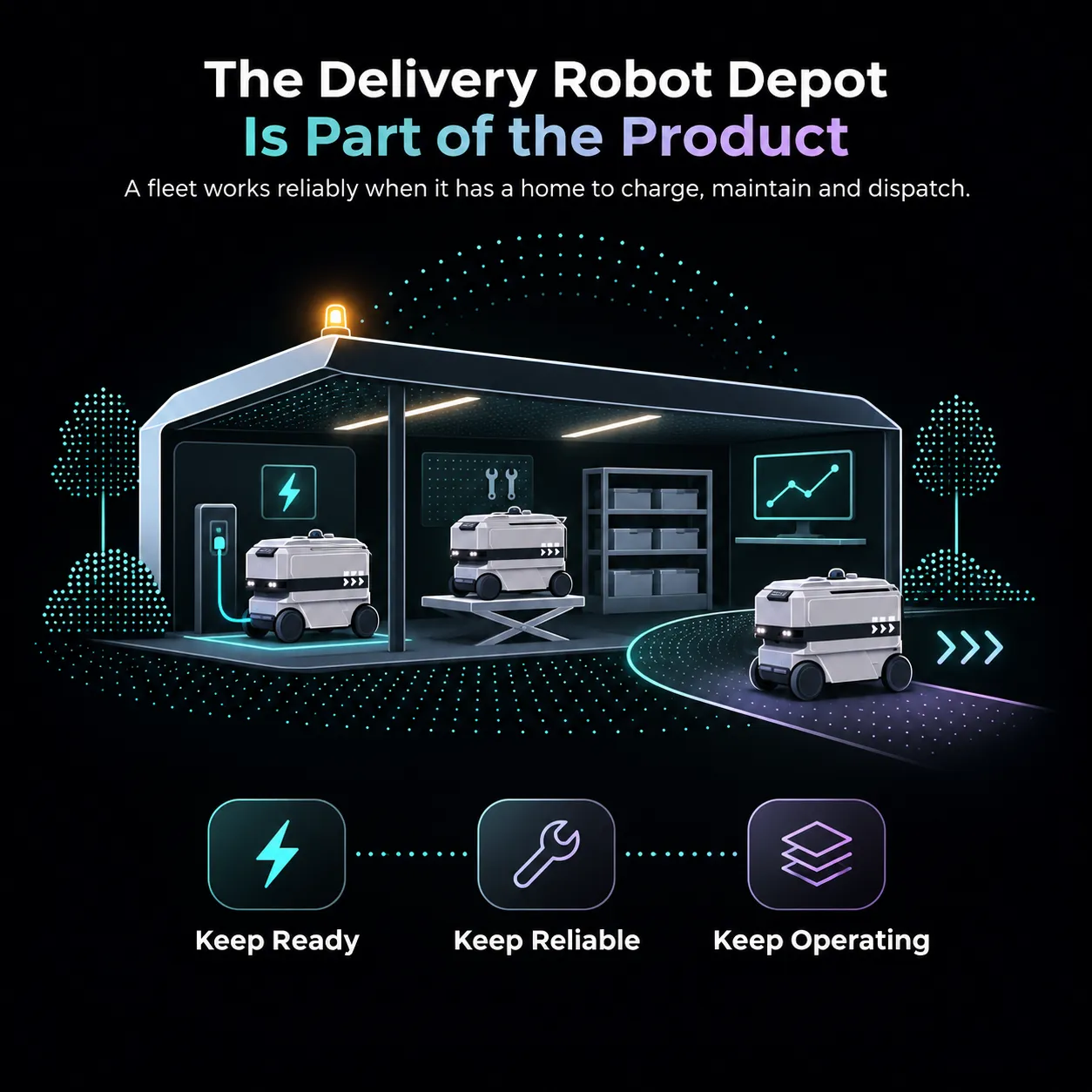
Delivery-robot design is usually discussed at the vehicle level: sensors, wheels, cargo capacity,
autonomy and handoff. Commercial deployments reveal another system that is just as important.
Robots need to be charged, cleaned, dispatched, inspected, repaired, stored, updated and recovered.
A recent overseas launch makes this operating layer unusually visible. The robot operator entered a
new country with a city partner, an established delivery platform and a university that hosts the fleet
depot and local team. The depot is not background real estate. It is the point where availability,
safety and support become operational.
What a micro-depot must do
- Provide secure overnight storage and charging with battery-health monitoring.
- Support fast cleaning of sensor windows, wheels and cargo compartments.
- Hold spares, tools and a quarantined area for faulty robots.
- Coordinate dispatch so multiple robots do not congest the departure path.
- Connect remote supervision with a local field-response commitment.
- Maintain public contact, incident records and software/version traceability.
The depot shapes RaaS economics
A low hardware price can be overwhelmed by high retrieval, cleaning, technician and teleoperation
cost. The right unit of analysis is therefore not the robot purchase price. It is the fully loaded cost per
productive robot-day: equipment, software, depot, energy, maintenance, supervision, field response,
insurance and integration amortization.
The smallest useful depot may be the best first product
City-scale infrastructure is not required for an initial deployment. A standardized two-to-five-robot
micro-depot can create a controlled operating base for a hospital, university, township or technology
park. If its interfaces and procedures are repeatable, it becomes an activation kit for the next site.
A proposed Fainzy deployment package would specify the depot alongside ZiBOT or an indoor
platform: power, footprint, approach path, charging, cleaning, spares, dispatch, remote link, retrieval
and response time. Those costs would be visible in the RaaS quote. This is a proposed operating
model, not a claim that a standardized depot network is already deployed.