Urban robot delivery is often described through route length, autonomy rate or the absence of
collisions. A recently disclosed Japanese trial makes a different contribution: it lists the human work
that kept the service operating for 312 hours in a complex pedestrian environment.
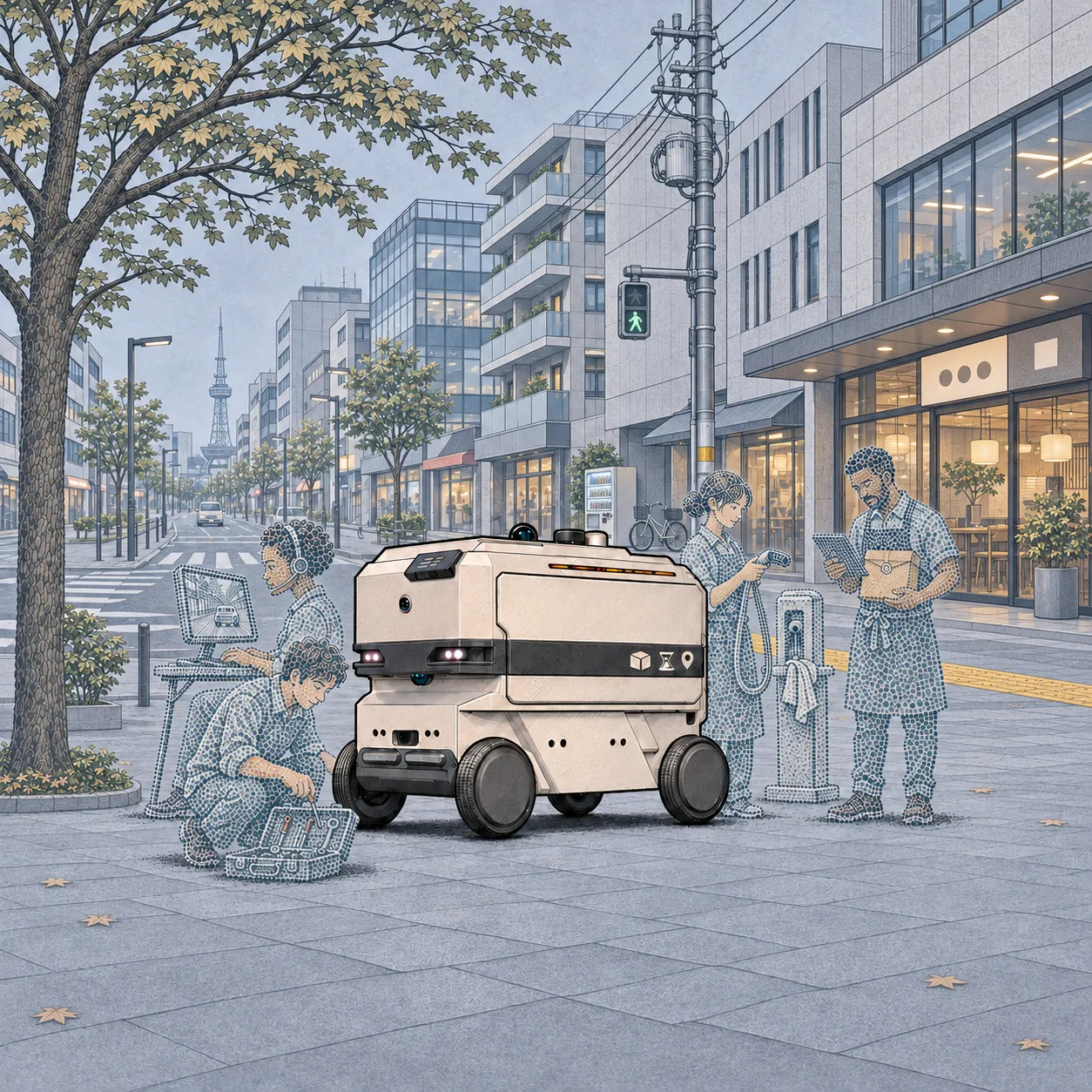
The support scope included continuous camera monitoring, rapid on-site recovery when a robot
stopped, coordination with restaurants, arrival notifications to customers, cleaning, charging and base
operations. The trial reported no major accidents, but the more useful lesson is that safety and
reliability were produced by a combined human-machine system.
Remote supervision is only one layer
A remote operator can diagnose and sometimes resolve an event. A blocked wheel, damaged panel,
inaccessible doorway or communications failure may still require a local person. Deployment planning
therefore needs response zones, travel-time targets, spare equipment and an escalation tree.
Operations work should be measurable
Field support becomes economically manageable when every intervention records its trigger, handling
time, travel time, resolution, affected missions and recurrence. Without that data, a fleet can appear
autonomous while quietly consuming expensive labour.
Merchant and customer communication are product functions
Delivery can fail even when navigation succeeds. Restaurants need a simple readiness signal,
customers need an arrival and authentication flow, and operators need a defined way to manage late
preparation or missed collection. These workflows should be visible in fleet software instead of living in
informal phone calls.
A proposed Fainzy pilot would define a remote-operations console, field-response service radius,
recovery playbooks, cleaning and charging schedule, merchant readiness flow, NFC or QR handoff, and
intervention-cost dashboard before go-live. This is a proposed operating design, not a claim about
current Fainzy deployment scale.
Autonomous delivery is not a robot plus a route. It is a staffed, measurable service architecture that
must remain safe when the robot cannot complete the mission alone.